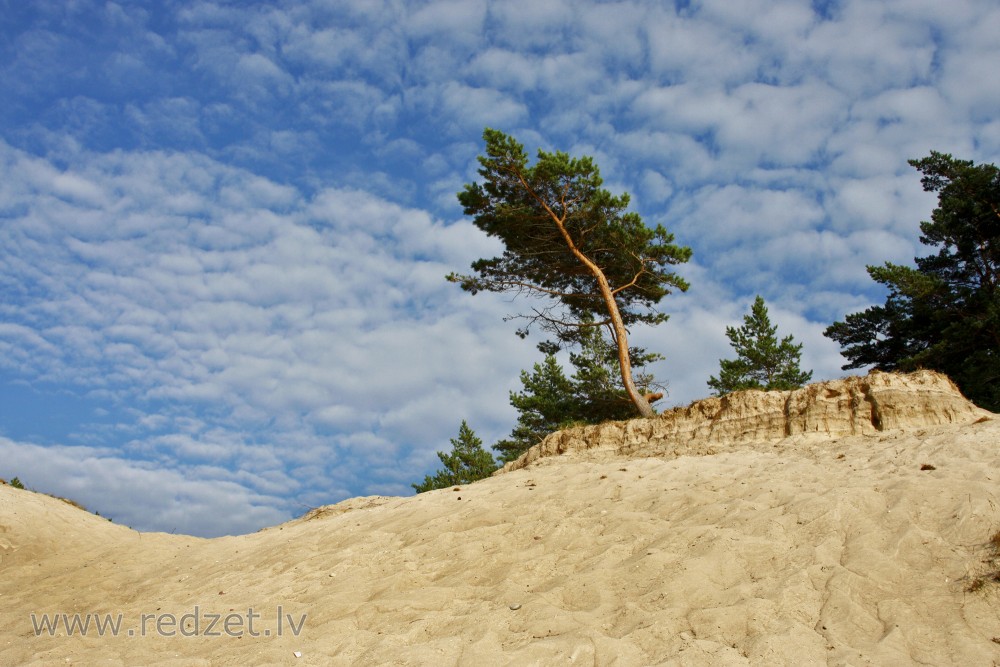
Sand dune

Sand dunes are common features of shoreline and desert environments. Dunes provide habitat for highly specialized plants and animals, including rare and endangered species. They can protect beaches from erosion and recruit sand to eroded beaches. Dunes are threatened by human activity, both intentional and unintentional. Countries such as the United States, Australia, Canada, New Zealand, the United Kingdom, and Netherlands, operate significant dune protection programs.
Stabilizing dunes involves multiple actions. Planting vegetation reduces the impact of wind and water. Wooden sand fences can help retain sand and other material needed for a healthy sand dune ecosystem. Footpaths protect dunes from damage from foot traffic. They can also protect beaches from erosion and recruit sand to eroded beaches and to many other places too .
The location of the dune limits the types of plant that can thrive there. Beach dunes consist of the foredune, the angled side which faces the ocean, the sand plain at the top of the dune, which may or may not be present, and the backdune, the angled side that faces away from the ocean.
en.wikipedia.org
In physical geography, a dune is a hill of loose sand built by aeolian processes (wind) or the flow of water. Dunes occur in different shapes and sizes, formed by interaction with the flow of air or water. Most kinds of dunes are longer on the stoss (upflow) side, where the sand is pushed up the dune, and have a shorter "slip face" in the lee side. The valley or trough between dunes is called a slack. A "dune field" or erg is an area covered by extensive dunes.
Dunes occur in some deserts and along some coasts. Some coastal areas have one or more sets of dunes running parallel to the shoreline directly inland from the beach. In most cases, the dunes are important in protecting the land against potential ravages by storm waves from the sea. Although the most widely distributed dunes are those associated with coastal regions, the largest complexes of dunes are found inland in dry regions and associated with ancient lake or sea beds. Dunes can form under the action of water flow (fluvial processes), and on sand or gravel beds of rivers, estuaries and the sea-bed.
The modern word "dune" came into English from French c. 1790, which in turn came from Middle Dutch dūne.
Formation
Dunes are made of sand-sized particles, and may consist of quartz, calcium carbonate, snow, gypsum, or other materials. The upwind/upstream/upcurrent side of the dune is called the stoss side; the downflow side is called the lee side. Sand is pushed (creep) or bounces (saltation) up the stoss side, and slides down the lee side. A side of a dune that the sand has slid down is called a slip face (or slipface).
The Bagnold formula gives the speed at which particles can be transported.
en.wikipedia.org