Salix - Willow
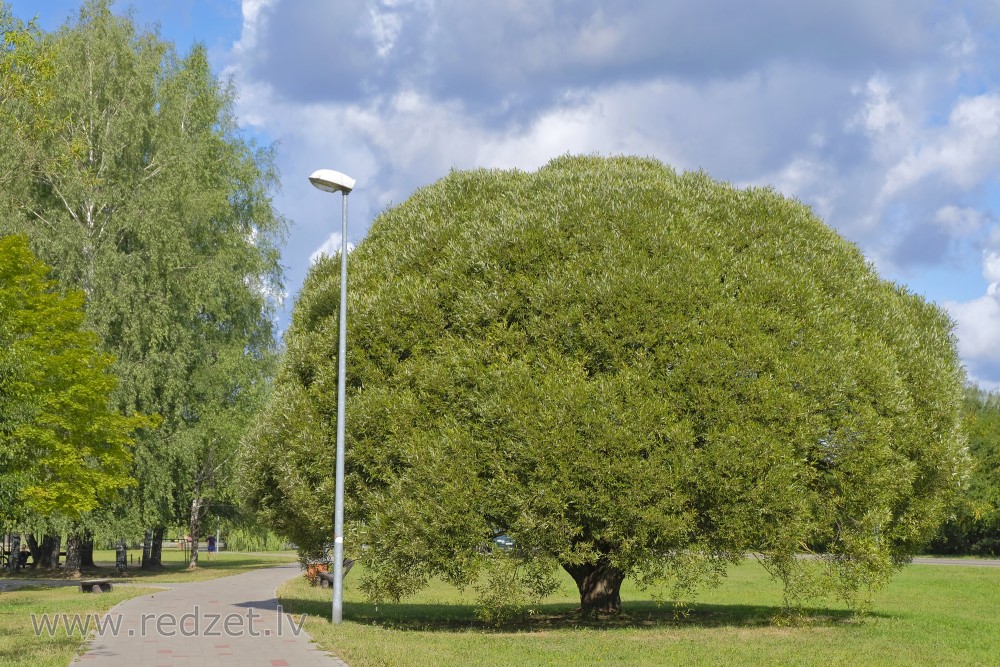
Willows, also called sallows, and osiers, form the genus Salix, around 400 species of deciduous trees and shrubs, found primarily on moist soils in cold and temperate regions of the Northern Hemisphere. Most species are known as willow, but some narrow-leaved shrub species are called osier, and some broader-leaved species are referred to as sallow (from Old English sealh, related to the Latin word salix, willow). Some willows (particularly arctic and alpine species) are low-growing or creeping shrubs; for example, the dwarf willow (Salix herbacea) rarely exceeds 6 cm (2.4 in) in height, though it spreads widely across the ground.
Description
Willows all have abundant watery bark sap, which is heavily charged with salicylic acid, soft, usually pliant, tough wood, slender branches, and large, fibrous, often stoloniferous roots. The roots are remarkable for their toughness, size, and tenacity to live, and roots readily sprout from aerial parts of the plant.
The leaves are typically elongated, but may also be round to oval, frequently with serrated edges. Most species are deciduous; semievergreen willows with coriaceous leaves are rare, e.g. Salix micans and S. australior in the eastern Mediterranean. All the buds are lateral; no absolutely terminal bud is ever formed. The buds are covered by a single scale. Usually, the bud scale is fused into a cap-like shape, but in some species it wraps around and the edges overlap. The leaves are simple, feather-veined, and typically linear-lanceolate. Usually they are serrate, rounded at base, acute or acuminate. The leaf petioles are short, the stipules often very conspicuous, resembling tiny, round leaves, and sometimes remaining for half the summer. On some species, however, they are small, inconspicuous, and caducous (soon falling). In color, the leaves show a great variety of greens, ranging from yellowish to bluish color.
Flowers
Willows are dioecious, with male and female flowers appearing as catkins on separate plants; the catkins are produced early in the spring, often before the leaves.
The staminate (male) flowers are without either calyx with corolla; they consist simply of stamens, varying in number from two to 10, accompanied by a nectariferous gland and inserted on the base of a scale which is itself borne on the rachis of a drooping raceme called a catkin, or ament. This scale is square, entire, and very hairy. The anthers are rose-colored in the bud, but orange or purple after the flower opens; they are two-celled and the cells open latitudinally. The filaments are threadlike, usually pale brown, and often bald.
The pistillate (female) flowers are also without calyx or corolla, and consist of a single ovary accompanied by a small, flat nectar gland and inserted on the base of a scale which is likewise borne on the rachis of a catkin. The ovary is one-celled, the style two-lobed, and the ovules numerous.
Cultivation
Almost all willows take root very readily from cuttings or where broken branches lie on the ground. The few exceptions include the goat willow (Salix caprea) and peachleaf willow (Salix amygdaloides). One famous example of such growth from cuttings involves the poet Alexander Pope, who begged a twig from a parcel tied with twigs sent from Spain to Lady Suffolk. This twig was planted and throve, and legend has it that all of England's weeping willows are descended from this first one.
Willows are often planted on the borders of streams so their interlacing roots may protect the bank against the action of the water. Frequently, the roots are much larger than the stem which grows from them.
Hybrids
Willows are very cross-compatible, and numerous hybrids occur, both naturally and in cultivation. A well-known ornamental example is the weeping willow (Salix × sepulcralis), which is a hybrid of Peking willow (Salix babylonica) from China and white willow (Salix alba) from Europe.
en.wikipedia.org
https://en.wikipedia.org/wiki/Willow
Continue reading