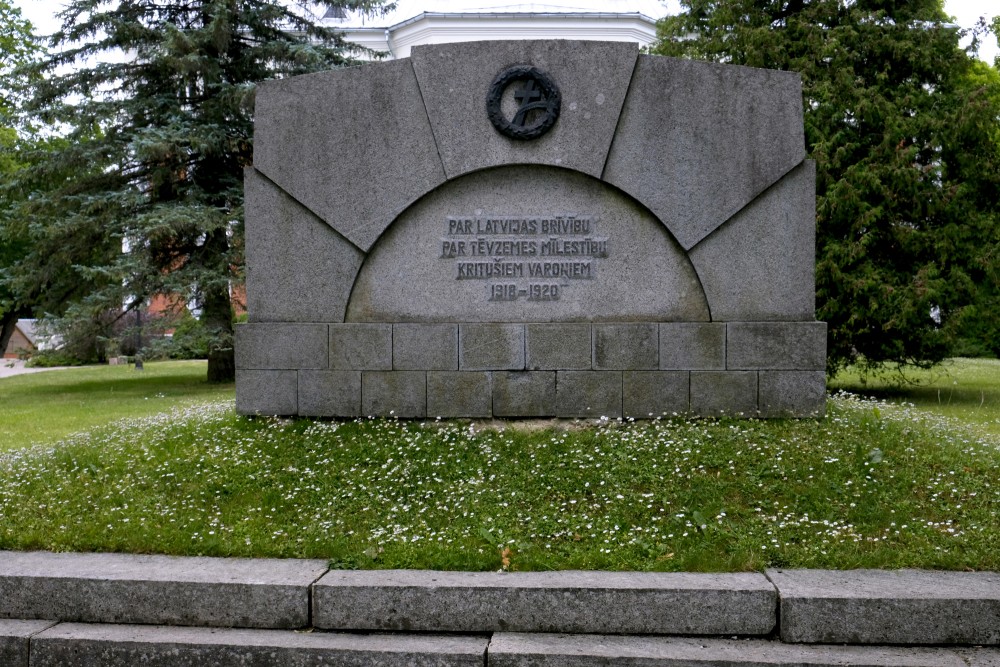
Monument to soldiers who fell in the Latvian Freedom Struggle (Bebrene)
Names in the sources: Monument to the memory of the Upland partisans who fell in the battles for the Liberation of Latvia.
"Freedom Monument" - a monument to the Latvian freedom struggles of 1918 - 1920. for the fallen. The monument to the soldiers who fell in the Latvian Freedom Struggle.
Author: Architect Aleksandar Birzeniek, under the guidance of engineer Ž. Komisar. After restoration on May 15, 1994, sculptor Igors Dobičinas and Ojars Arvīds Feldbergs, architect Ruta Dobičinas.
Material: Granite
Form: Architectural ensemble
Dimensions: 225 x 350 x 80 cm
Location: Ilūkstes county (2019), Bebrene parish, near the Bebrene comprehensive and vocational secondary school, which was the castle of the Bebrene estate
Opened: August 14, 1932, renovated in 1994
Inscriptions: FOR THE FREEDOM OF LATVIA, FOR THE LOVE OF THE FATHER - FALLEN HEROES. 1918 - 1920
FROM THE SWORD THE SUN RISES, THROUGH THE SWORD WE ARE FREE.
History: Bebrene Castle is located in front of it. Demolished after the Second World War, demolished in the 20th century. In the 1950s, restored and opened on May 15, 1994 by sculptor Igors Dobičins and Ojārs Arvīds Feldbergs, architect Ruta Dobičina.
1932. on the front of the monument opened in 2011, in a semi-circular depression, an inscription is carved into a black granite slab: "FOR THE FREEDOM OF LATVIA, FOR THE LOVE OF THE FATHER FOR THE FALLEN HEROES. 1918-1920". Above the semicircle is a bronze flag with a cross in the middle. On the other side of the monument, there is a bronze tab - a rising sun and the text: "FROM THE SWORD THE SUN ROSE, THROUGH THE SWORD WE ARE FREE". In the 1950s, the monument was demolished by the Soviet occupation authorities, and in the mid-1970s, a monument to fallen Red Army soldiers was erected instead.
The events of the First World War and the Freedom Struggle: "1915 In August and September, German troops occupied Bebren. During the First World War, there was a front line in the vicinity of Bebrene, and the population was evacuated. In 1916, the German occupation administration built several narrow-gauge railway lines through Bebrene parish for the army's supply needs. In December 1918, Ilūkste district was occupied by the troops of the magnates and a short period of Soviet dictatorship began. In May 1919, groups of local partisans were organized in Bebrene and June in Rubene (the Upper Kurzeme partisan regiment was created under the leadership of First Lieutenant Jānis Teodoras Indāns), which at first became part of the Lithuanian Army, and later - the 3rd Jelgava Infantry Regiment of the Latvian Army. In the summer, the bigots were expelled from the territory of the parish and the activity of the municipality was restored. 1919-20 in the year after the expulsion of the Red Army, a significant part of Ilūkste district, i.e. see The area around Bebrene was in the territory controlled by the Lithuanian troops."
latvijaspieminekli.lv