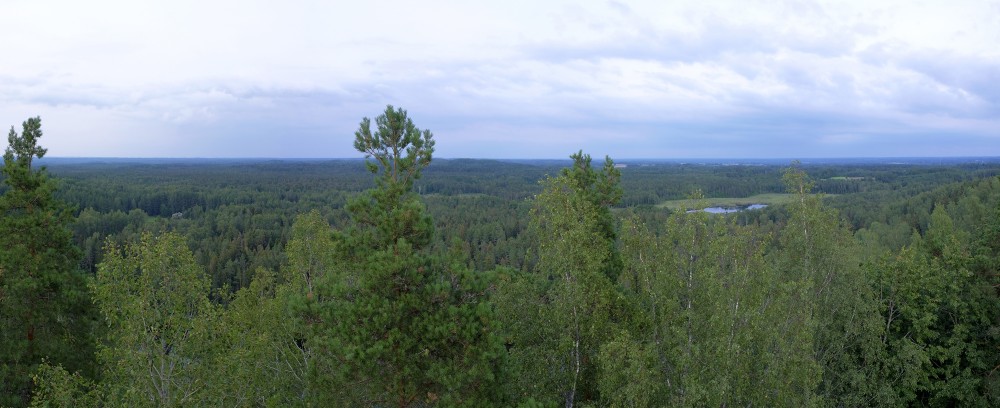
Krustkalni Nature Reserve
Krustkalni Nature Reserve (Latvian: Krustkalnu dabas rezervāts) is a nature reserve located in eastern Latvia that was founded in 1977. Its area is 2978 hectares. Since 2004, this institution has been part of Natura 2000, the European network of protected areas. The reserve is managed by the regional administration Latgale.
The objects of protection in the Krustkalni Nature Reserve are special landscapes Madonas – Trepes valnis with a complex of coniferous forests and meadows, as well as underground springs that form small swamps and lakes. A feature of these sources is the high content of calcium, due to which limestone soils are formed. They grow on calciphile plant species, which often occur in the coastal areas of the country, but are not typical of eastern Latvia. The reserve has 32 species of plants and 37 species of animals listed in the Red Book of Latvia, and the number of Red Book plants in Krustkalni ranks second among the country's reserves.
History
The Krustkalni lands belonged to the Krustkalni forest research station prior to the creation of the reserve. Even before the establishment of the protected area, both Baltic German and Latvian naturalists, including Nikolajs Malta [lv], knew that this region had the richest flora of Eastern Latvia. Due to the difficult terrain, these areas were challenging to cultivate and impossible to apply intensive methods of forestry. At the same time, due to the height differences and the variety of landscapes, this area was characterized by rich vegetation and interesting fauna. Given these two factors, From the 1950s, researchers from both the University of Latvia and the University of Latvia Institute of Biology [lv] began to explore the area, and it became a venue for student field internships. Under the leadership of the Institute of Biology, the first nature reserve in Eastern Latvia was established there on April 15, 1977. In total 69 land lots of the forest became a nature reserve, but temporarily remained in use by the research station. In 1979, the Slitere State Nature Reserve was established, to which all other Latvian reserves, including Krustkalni, were subordinated. In 1982, another reserve was organized in the east of Latvia – Teiči Nature Reserve. Since Teiči reserve was located in the same region as Krustkalni, a joint administration was established for these two reserves, subordinated to the Latvian Production Forestry Association "Latvias Mejs". Since February 1, 2011, the joint administration of both East Latvian reserves has been operating under the direction of the regional administration in Latgale.
Climate
Krustkalni Nature Reserve is located in the transition zone between Central Vidzeme Upland with its harsh climate and Lubāna Lowland [lv], which is dominated by warmer continental air. The influence of the coastal climate on its territory is weakened due to the relative separation from the coast of the Baltic Sea and the Middle Latvian uplands. The frost–free period, with temperatures above 5 °C, lasts 180 days. The average minimum temperatures are –28 °C. 600 mm precipitation falls here per year, which are distributed as follows: about 350 mm evaporates, and 250 mm create surface runoff. The strong articulation of the terrain determines the diversity microclimatic conditions in parts of the reserve.
Geography and hydrology
Krustkalni Nature Reserve is located in the east of Latvia, on the conditional border that separates the historical regions of Vidzeme and Latgale. Its territory lies entirely within the Madona Municipality, the center of which, the city Madona, is located 15 km from the boundaries of the protected area. The outlines of the reserve resemble a triangle, which in the northwest reaches the village of Mārciena [lv], in the northeast is bounded by the road Madona – Jēkabpils, and in the south – the river Aiviekste, which flows on the outskirts of the village Ļaudona.
The area of the reserve lies on Middle Daugava Lowland [lv], however, the nature of the terrain is more similar to the nearby Central Vidzeme Upland. During the last ice age on these lands there was a strong deposition of water-glacial material, which formed Madonsko-Trepsky shaft. Krustalny occupies its narrowest part from Lake Dreimaņa (also known as Svētes, Latvian: Dreimaņa ezers[6]) in the north to the river Iviekste in the south. Within the reserve, the shaft consists of 2–5 ridges, up to 4 km long, with a total width of 1–2 km and 153 m above sea level. Basically, each of these ridges is 70 to 250 meters wide, has relative height of up to 50 m and a steep slope of about 35°. Between the ridges are lowlands (well drained or swampy) and wide ravines.
Along the south-eastern slope of the Madonsko-Trepsky shaft stretches the Dooku-Svetes depression, located at absolute heights of 95–100 m. It is flat and represents the bottom of an ancient lake that existed here in Holocene. A large amount of carbonates was deposited on this lake, and for some time lime was even mined industrially. Now on the site of the former quarries there are ponds that have gradually overgrown and turned into meadows.
The territory of the Krustkalni Nature Reserve is rich in reservoirs, which can be divided into three types: lakes, rivers and springs. The largest in area are the lakes, of which there are 13. Among them is Lake Dreimaņa, on the southwestern shore of which formed a one and a half kilometer peninsula. Like other lakes concentrated in the eastern part of the protected area, Dreimaņa has marshy shores and a bottom composed of limestone with layers of silt. From this lake flows the river Svetupe, which flows through the central part of the Dooku-Svetes depression to the south, absorbs the tributary of the Nidrīte [lv] and flows into the river Aiviekste. Another river – Nīdreite [lv] – has a source supply and encircles the reserve from the southwest. All these rivers are small, winding, with low banks and rich vegetation. Krustkalni springs are concentrated at the foot of the hills and on the shores of Lake Dreimaņa.
en.wikipedia.org