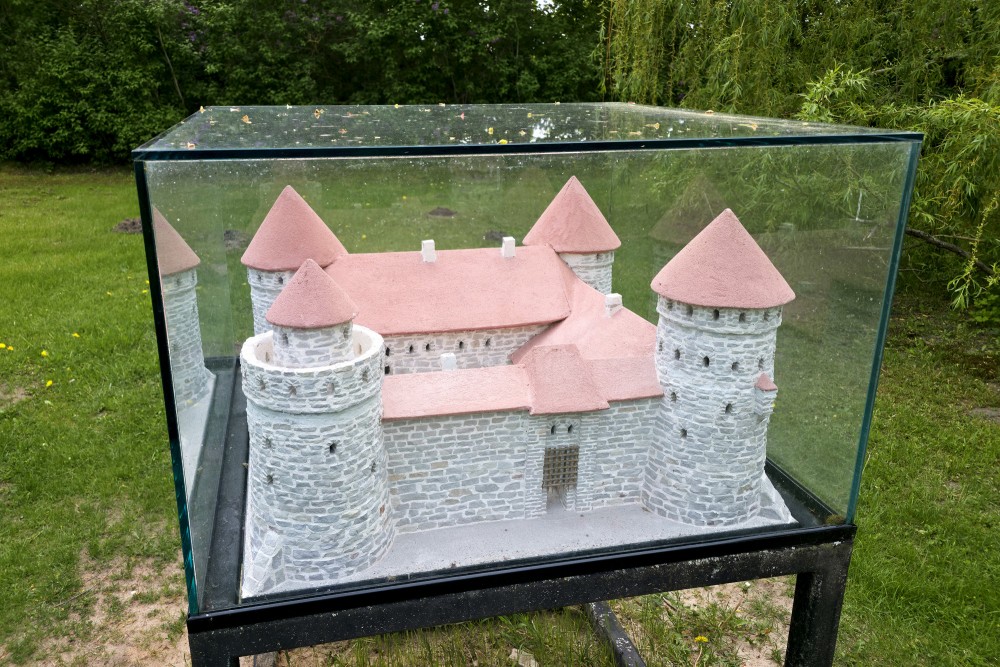
Jaundole castle model
Brief History
New Dole Castle (Jaundoles pils) was built in the first half of the 14th century (after 1316) by the Riga Cathedral Chapter. It replaced the former Old Dole Castle (Vecdoles pils), which had been destroyed by the Livonian Order during internal crusader conflicts. The castle was strategically positioned near the mouth of the Lebjava stream into the Dry Daugava (Sausā Daugava). It stood until the Polish–Swedish War when, in 1627, the retreating Swedish army blew it up to prevent its military use by enemies. The fortress was never rebuilt, and Dole Manor was established adjacent to the site in 1631.
Architectural Characteristics and the Model
Historically, New Dole Castle was a stone fortress of the castella type, featuring a dominant, freestanding round defensive tower (donjon) serving as its primary stronghold. Today, only minimal ground-level masonry fragments remain hidden within the nature park. To offer visitors a clear understanding of the lost heritage, a physical reconstruction model stands in the open-air territory of the Daugava Museum, detailing the defensive layout, outer walls, and the central tower.
Modern Function and Interesting Facts
-
Function: The model serves as an educational open-air exhibit within the Daugava Museum park, allowing visitors to visualize medieval local history before the construction of the hydroelectric dams altered the Daugava river valley.
-
Fact: After the castle was blown up, its ruins became a quarry. In the 17th and 18th centuries, the stone blocks were repurposed to construct the buildings of the new Dole Manor complex.