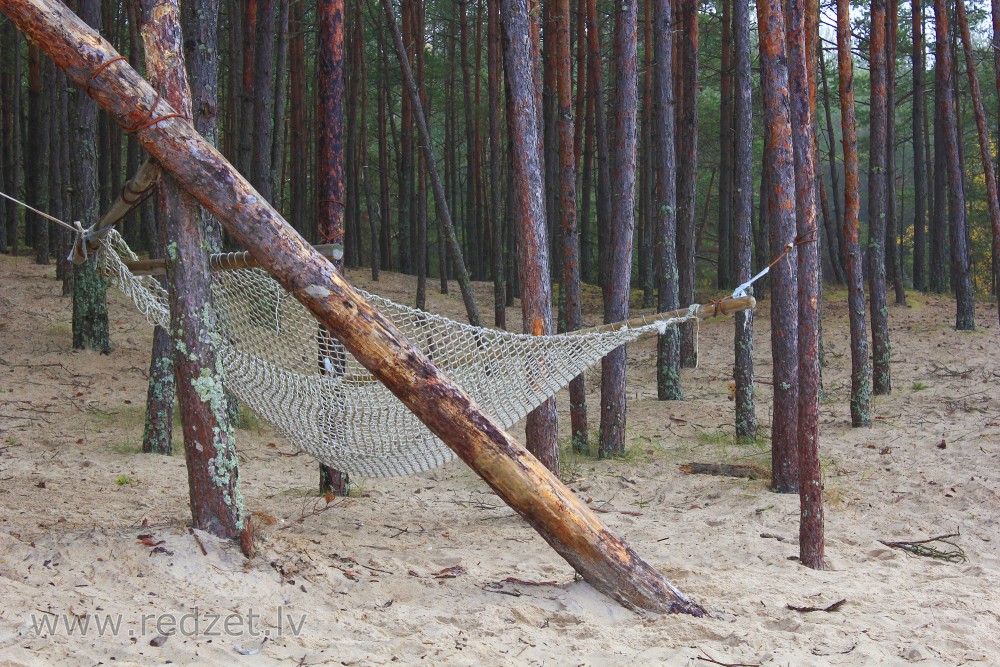
Hammock

A hammock (from Spanish hamaca, borrowed from Taino and Arawak hamaka) is a sling made of fabric, rope, or netting, suspended between two or more points, used for swinging, sleeping, or resting. It normally consists of one or more cloth panels, or a woven network of twine or thin rope stretched with ropes between two firm anchor points such as trees or posts. Hammocks were developed by native inhabitants of Central and South America for sleeping. Later, they were used aboard ships by sailors to enable comfort and maximize available space, and by explorers or soldiers travelling in wooded regions. Eventually, in the 1920s, parents throughout North America used fabric hammocks to contain babies just learning to crawl. Today they are popular around the world for relaxation; they are also used as a lightweight bed on camping trips. The hammock is often seen as a symbol of summer, leisure, relaxation and simple, easy living.
History
Spanish colonists noted the use of the hammock by Native Americans, particularly in the West Indies, at the time of the Spanish conquest.
Columbus, in the narrative of his first voyage, says: “A great many Indians in canoes came to the ship to-day for the purpose of bartering their cotton, and hamacas, or nets, in which they sleep.”
The word comes from a Taíno culture Arawakan word (Haiti) meaning "stretch of cloth" from the Arawak root -maka.
Early hammocks were woven out of tree bark, and later this material was replaced by sisal fibers because it was more abundant. One of the reasons that hammocks became popular in Central and South America was their ability to provide safety from disease transmission, insect stings, or animal bites. By suspending their beds above ground, inhabitants were better protected from snakes, biting ants, and other harmful creatures.
The origin of the hammock in the Americas is often obscured in English-language sources from the late 18th century onward. Samuel Johnson claimed that the word hammock was of Saxon origin. This etymology was soon debunked, and later 19th-century sources attributed the invention to the Athenian politician Alcibiades. This was inferred from Plutarch, who wrote that Alcibiades had his galley bed hung from ropes, but did not specifically describe it as a net or sling. A few European sources mention the historical use of cloth slings as carriage seats, but not as regular beds.
Current Usage
There are currently a wide variety of hammocks available. There are hammocks that are designed specifically for backpacking and include mosquito netting along with pockets for nighttime storage. There are hammocks made out of thin and lightweight material which makes them ideal for taking on daytrips. Other hammocks include self-standing metal or wood structures that support the hammock. Given that hammocks are commonly similar lengths to accommodate for an average adult's height, most hammock stands are universal in design, typically featuring a spreader bar that runs along the ground, feet for stability at each end, and a diagonal arm at each end to provide two hanging points. Although they are usually bought premade, it is also possible to make your own hammock.
Hammocks are very popular in the Brazilian northeast region, but not only as sleeping devices: in the poorest areas of the sertão, if there is not a cemetery in a settlement, hammocks may be used to carry the dead to a locale where there is one; also, they frequently serve as a low-cost alternative to coffins. This custom inspired Candido Portinari's 1944 painting Enterro na Rede ("burial in the hammock"). Traditionally the sailors who have died at sea were buried at sea in their hammocks.
Medical research suggests the gentle rocking motion of the hammock allows users to fall asleep faster and sleep more deeply compared to a traditional, stationary mattress.
en.wikipedia.org