Euphorbia
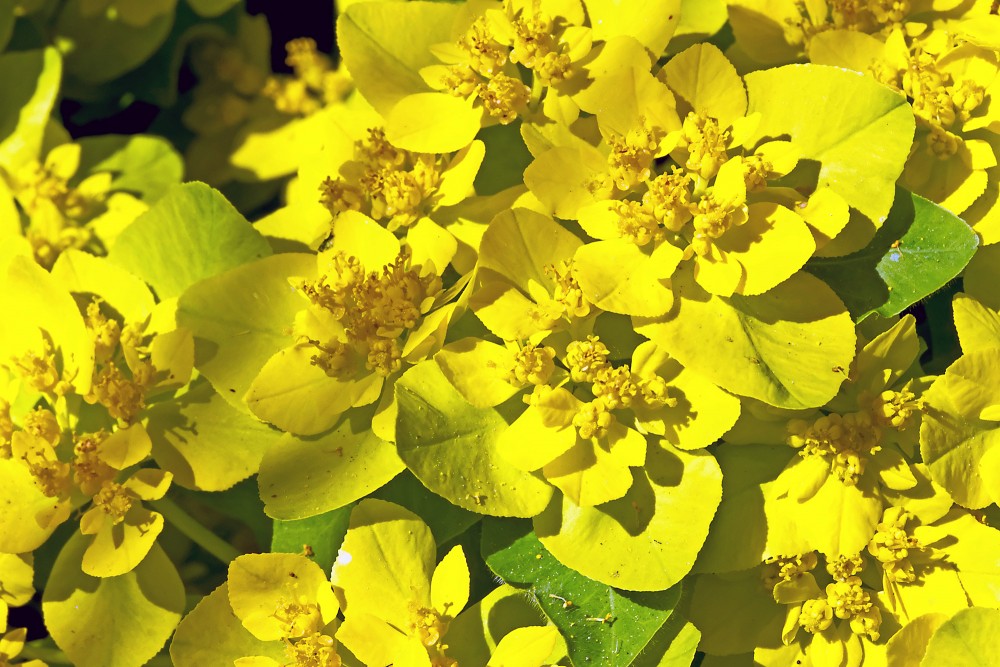
Euphorbia is a very large and diverse genus of flowering plants, commonly called spurge, in the spurge family (Euphorbiaceae). "Euphorbia" is sometimes used in ordinary English to collectively refer to all members of Euphorbiaceae (in deference to the type genus), not just to members of the genus. Some euphorbias are commercially widely available, such as poinsettias at Christmas. Some are commonly cultivated as ornamentals, or collected and highly valued for the aesthetic appearance of their unique floral structures, such as the crown of thorns plant (Euphorbia milii). Euphorbias from the deserts of Southern Africa and Madagascar have evolved physical characteristics and forms similar to cacti of North and South America, so they (along with various other kinds of plants) are often incorrectly referred to as cacti. Some are used as ornamentals in landscaping, because of beautiful or striking overall forms, and drought and heat tolerance.
Euphorbias range from tiny annual plants to large and long-lived trees. The genus has over or about 2,000 members, making it one of the largest genera of flowering plants. It also has one of the largest ranges of chromosome counts, along with Rumex and Senecio. Euphorbia antiquorum is the type species for the genus Euphorbia. It was first described by Carl Linnaeus in 1753 in Species Plantarum.
The plants share the feature of having a poisonous, milky, white, latex-like sap, and unusual and unique floral structures. The genus may be described by properties of its members' gene sequences, or by the shape and form (morphology) of its heads of flowers. When viewed as a whole, the head of flowers looks like a single flower (a pseudanthium). It has a unique kind of pseudanthium, called a cyathium, where each flower in the head is reduced to its barest essential part needed for sexual reproduction. The individual flowers are either male or female, with the male flowers reduced to only the stamen, and the females to the pistil. These flowers have no sepals, petals, or other parts that are typical of flowers in other kinds of plants. Structures supporting the flower head and beneath have evolved to attract pollinators with nectar, and with shapes and colors that function the way petals and other flower parts do in other flowers. It is the only genus of plants that has all three kinds of photosynthesis, CAM, C3 and C4.
The genus can be found all over the world. The forms range from annual plants lying on the ground, to well-developed tall trees. In deserts in Madagascar and southern Africa, convergent evolution has led to cactus-like forms where the plants occupy the same ecological niche as cacti do in deserts of North and South America. The genus is primarily found in the tropical and subtropical regions of Africa and the Americas, but also in temperate zones worldwide. Succulent species originate mostly from Africa, the Americas, and Madagascar. A wide range of insular species can be found.
| Euphorbia | |
| Kingdom: | Plantae |
| Clade: | Angiosperms |
| Clade: | Eudicots |
| Clade: | Rosids |
| Order: | Malpighiales |
| Family: | Euphorbiaceae |
| Subfamily: | Euphorbioideae |
| Tribe: | Euphorbieae |
| Subtribe: | Euphorbiinae |
| Genus: | Euphorbia |
Description
The plants are annual, biennial or perennial herbs, woody shrubs, or trees with a caustic, poisonous milky latex. The roots are fine or thick and fleshy or tuberous. Many species are more or less succulent, thorny, or unarmed. The main stem and mostly also the side arms of the succulent species are thick and fleshy, 15–91 cm (6–36 in) tall. The deciduous[citation needed] leaves may be opposite, alternate, or in whorls. In succulent species, the leaves are mostly small and short-lived. The stipules are mostly small, partly transformed into spines or glands, or missing.
Inflorescence and fruit
Like all members of the family Euphorbiaceae, spurges have unisexual flowers.
In Euphorbia, flowers occur in a head, called the cyathium (plural cyathia). Each male or female flower in the cyathium head has only its essential sexual part, in males the stamen, and in females the pistil. The flowers do not have sepals, petals, or nectar to attract pollinators, although other nonflower parts of the plant have an appearance and nectar glands with similar roles. Euphorbias are the only plants known to have this kind of flower head.
Nectar glands and nectar that attract pollinators are held in the involucre, a cuplike part below and supporting the cyathium head. (The "involucre" in the genus Euphorbia is not to be confused with the "involucre" in family Asteraceae members, which is a collection of bracts called (phyllaries), which surround and encase the unopened flower head, then support the receptacle under it after the flower head opens.)
The involucre is above and supported by bract-like modified leaf structures (usually in pairs)[citation needed] called cyathophylls', or cyathial leaves. The cyathophyll often has a superficial appearance of being petals of a flower.
Euphorbia flowers are tiny, and the variation attracting different pollinators (and the human eye), with different forms and colors occurs, in the cyathium, involucre, cyathophyll, or additional parts such as glands that attached to these.
The collection of many flowers may be shaped and arranged to appear collectively as a single individual flower, sometimes called a pseudanthium in the Asteraceae, and also in Euphorbia.
The majority of species are monoecious (bearing male and female flowers on the same plant), although some are dioecious with male and female flowers occurring on different plants. It is not unusual for the central cyathia of a cyme to be purely male, and for lateral cyathia to carry both sexes. Sometimes, young plants or those growing under unfavorable conditions are male only, and only produce female flowers in the cyathia with maturity or as growing conditions improve.
The female flowers reduced to a single pistil usually split into three parts, often with two stigmas at each tip. Male flowers often have anthers in twos. Nectar glands usually occur in fives, may be as few as one, and may be fused into a "U" shape. The cyathophylls often occur in twos, are leaf-like, and may be showy and brightly coloured and attractive to pollinators, or be reduced to barely visible tiny scales.
The fruits are three- or rarely two-compartment capsules, sometimes fleshy, but almost always ripening to a woody container that then splits open, sometimes explosively. The seeds are four-angled, oval, or spherical, and some species have a caruncle.
Xerophytes and succulents
In the genus Euphorbia, succulence in the species has often evolved divergently and to differing degrees. Sometimes, it is difficult to decide, and is a question of interpretation, whether or not a species is really succulent or "only" xerophytic. In some cases, especially with geophytes, plants closely related to the succulents are normal herbs. About 850 species are succulent in the strictest sense. If one includes slightly succulent and xerophytic species, this figure rises to about 1000, representing about 45% of all Euphorbia species.
Irritants
The milky sap of spurges (called "latex") evolved as a deterrent to herbivores. It is white, and transparent when dry, except in E. abdelkuri, where it is yellow. The pressurized sap seeps from the slightest wound and congeals after a few minutes in air. The skin-irritating and caustic effects are largely caused by varying amounts of diterpenes. Triterpenes such as betulin and corresponding esters are other major components of the latex. In contact with mucous membranes (eyes, nose, mouth), the latex can produce extremely painful inflammation. Therefore, spurges should be handled with caution and kept away from children and pets. Latex on skin should be washed off immediately and thoroughly. Congealed latex is insoluble in water, but can be removed with an emulsifier such as milk or soap. A physician should be consulted if inflammation occurs, as severe eye damage including permanent blindness may result from exposure to the sap. When large succulent spurges in a greenhouse are cut, vapours can cause irritation to the eyes and throat several metres away. Precautions, including sufficient ventilation, are required.
Uses
Several spurges are grown as garden plants, among them poinsettia (E. pulcherrima) and the succulent E. trigona. E. pekinensis (Chinese: 大戟; pinyin: dàjǐ) is used in traditional Chinese medicine, where it is regarded as one of the 50 fundamental herbs. Several Euphorbia species are used as food plants by the larvae of some Lepidoptera (butterflies and moths), like the spurge hawk-moths (Hyles euphorbiae and Hyles tithymali), as well as the giant leopard moth.
Ingenol mebutate, a drug used to treat actinic keratosis, is a diterpenoid found in Euphorbia peplus.
Euphorbias are often used as hedging plants in many parts of Africa.
en.wikipedia.org
