Cortinarius mucosus (Orange webcap)
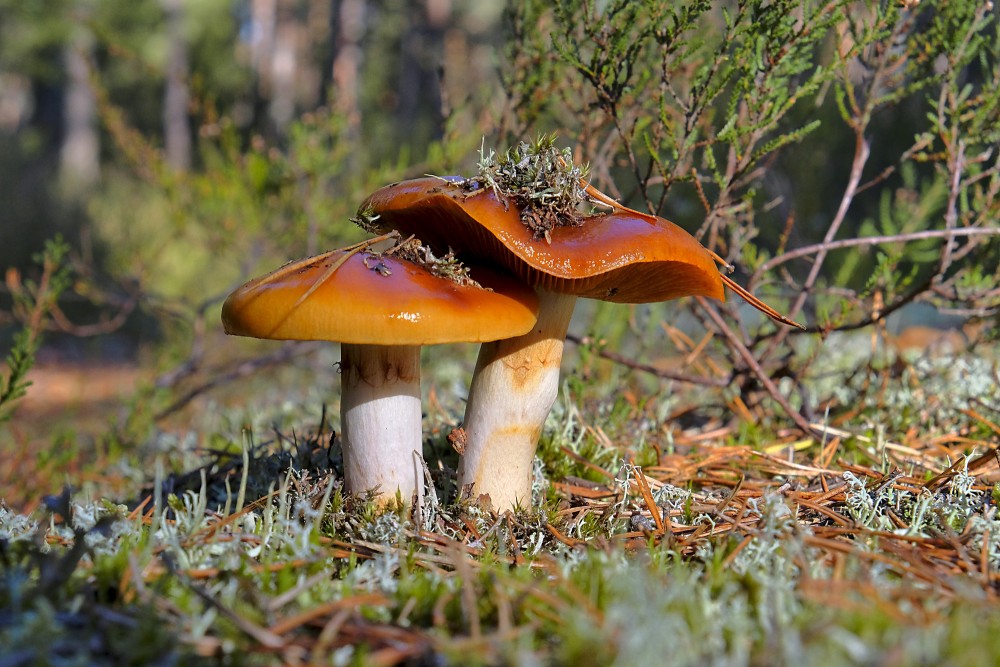
Cortinarius mucosus, commonly known as the orange webcap or the slimy cortinarius, is a species of fungus in the family Cortinariaceae. In North America, the species is more commonly associated with northern coniferous forests.
Taxonomy
Originally described as Agaricus mucosus by French mycologist Pierre Bulliard in 1792, Cortinarius mucosus belongs to the subgenus Myxacium (characterized by the presence of a viscid to glutinous outer veil and stipe), section Myxacium (distinguished by the presence of clamp connections), according to the infrageneric classification of the genus Cortinarius proposed by Moser in Singer (1986).
The specific epithet is derived from the Latin word mucosus, meaning mucus.
Description
The species has a sticky brown to orange cap, 4 to 10 centimetres (1+1⁄2 to 4 in) in diameter, that is darker towards the center and with a rolled-in margin. Similar to most species in the genus Cortinarius, young specimens have a cortina, a cobweb-like annulus that protects the developing gills. The gills are closely spaced, have an adnexed attachment to the stipe, and are pale yellowish at first, becoming rusty brown as the spores mature. The slimy stipe, 5 to 15 cm (2 to 6 in) long by 1.5 to 2.5 cm (1⁄2 to 1 in) thick, is whitish until the spores mature and begin falling. The spore print is rust- to ochre-colored. Both the odor and the taste of the mushroom are undistinguished.
The spores have a rough surface, and an elliptical shape, with dimensions of 12–14 x 5.5–6.5 μm. The basidia are 4-spored, and cystidia are not present on the edge of the gills.
en.wikipedia.org