Arctium lappa
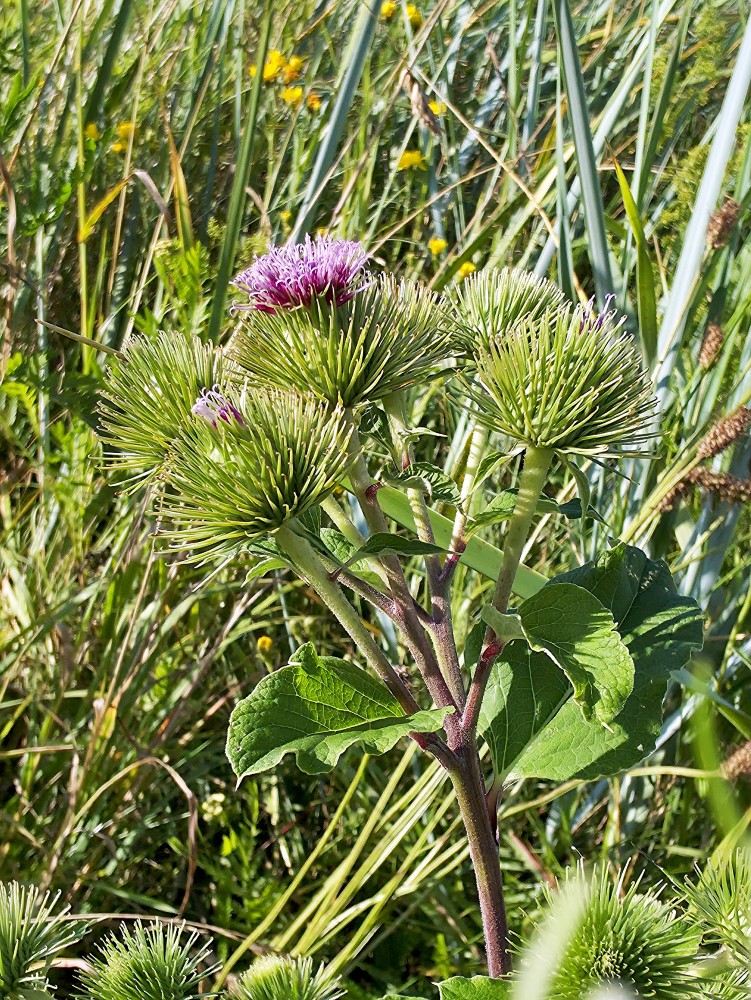
Arctium lappa, commonly called greater burdock, edible burdock, lappa, beggar's buttons, thorny burr, or happy major is a Eurasian species of plants in the family Asteraceae, cultivated in gardens for its root used as a vegetable. It has become an invasive weed of high-nitrogen soils in North America, Australia, and other regions.
| Arctium lappa | |
| Kingdom: | Plantae |
| Clade: | Tracheophytes |
| Clade: | Angiosperms |
| Clade: | Eudicots |
| Clade: | Asterids |
| Order: | Asterales |
| Family: | Asteraceae |
| Genus: | Arctium |
| Species: | A. lappa |
Description
Greater burdock is a biennial plant, rather tall, reaching as much as 3 metres (10 feet). It has large, alternating, wavy-edged cordiform leaves that have a long petiole and are pubescent on the underside.
The flowers are purple and grouped in globular capitula, united in clusters. They appear in mid-summer, from July to September. The capitula are surrounded by an involucre made out of many bracts, each curving to form a hook, allowing the mature fruits to be carried long distances on the fur of animals. The fruits are achenes; they are long, compressed, with short pappus hairs. These are a potential hazard for humans, horses, and dogs. The minute, sharply-pointed, bristly pappus hairs easily detach from the top of the achenes and are carried by the slightest breeze – attaching to skin, mucous membranes, and eyes where they can cause severe dermal irritation, possible respiratory manifestations, and ophthalmia. The fleshy taproot can grow up to 1 m (3 ft 3 in) deep.
en.wikipedia.org