Amanita muscaria (Fly agaric)
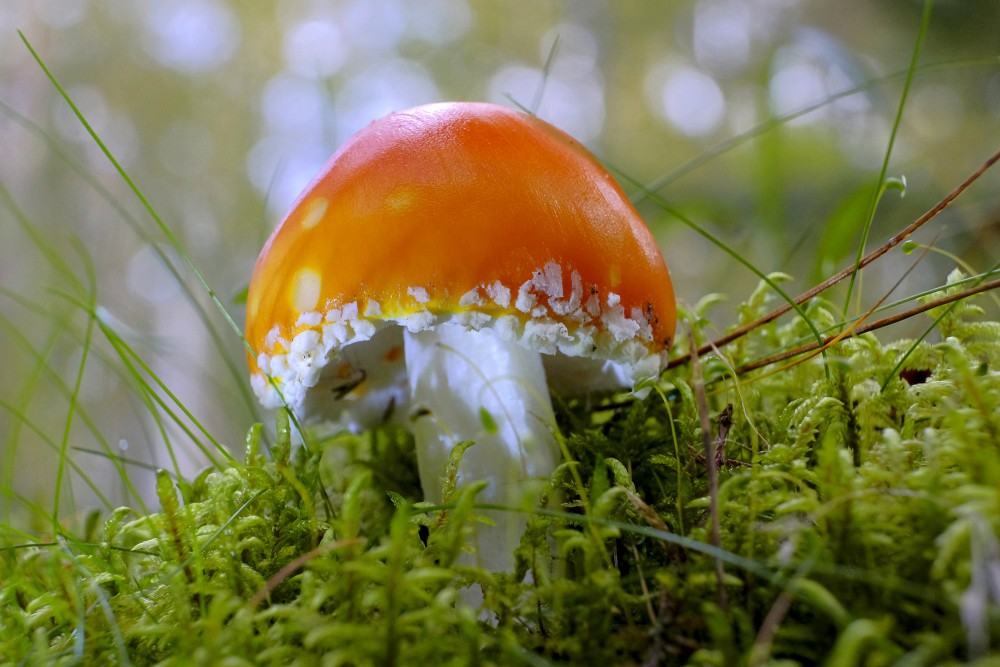
Amanita muscaria, commonly known as the fly agaric or fly amanita, is a basidiomycete fungus of the genus Amanita. Its common name derives from its traditional use as an insecticide. It is a distinctive, large white-gilled mushroom typically featuring a bright red cap covered with white warts. The complex genetic diversity of A. muscaria suggests that it is a species complex. It is a widely distributed mushroom native to temperate and boreal forests of the Northern Hemisphere, now also naturalised in the Southern Hemisphere, forming symbiotic relationships with various trees and spreading invasively in some regions.
Ingestion of the mushroom can cause poisoning, especially in children and those seeking its hallucinogenic effects, due to psychoactive compounds like muscimol and the ibotenic acid; however, fatal poisonings are extremely rare. Parboiling reduces toxicity, though drying converts ibotenic acid into muscimol, retaining psychoactive effects. Some cultures use it as food after preparation. Indigenous peoples of Siberia used A. muscaria as an inebriant and entheogen. It has been controversially linked to Santa Claus, Viking berserkers, Vedic soma, and early Christianity, though evidence is sparse and disputed. Its rise in the 2020s as a legal hallucinogen alternative has led to Food and Drug Administration scrutiny.
A. muscaria has appeared in art and literature since the Renaissance, becoming iconic in fairy tales, children’s books, and media like Disney’s Fantasia (1940) and the Super Mario video games. It has also influenced literary depictions of altered perception—most notably in Alice’s Adventures in Wonderland—and has been referenced in novels by writers including Oliver Goldsmith, Thomas Pynchon, and Alan Garner.
Description
A large, conspicuous mushroom, A. muscaria is generally common and numerous where it grows, and is often found in groups with basidiocarps in all stages of development.
Fly agaric fruiting bodies emerge from the soil looking like white eggs. After emerging from the ground, the cap is covered with numerous small white to yellow pyramid-shaped warts. These are remnants of the universal veil, a membrane that encloses the entire mushroom when it is still very young. Dissecting the mushroom at this stage reveals a characteristic yellowish layer of skin under the veil, which helps identification. As the fungus grows, the red colour appears through the broken veil and the warts become less prominent; they do not change in size, but are reduced relative to the expanding skin area. The cap changes from globose to hemispherical and finally to plate-like in mature specimens. The bright red cap ranges from 5–30 centimetres (2–12 inches) in diameter. Age and rain may cause the red colour to fade and the warts to fall off.
The free gills are white, as is the spore print. The oval spores measure 9–13 by 6.5–9 μm; they do not turn blue with the application of iodine. The stipe is white, 5–20 cm (2–8 in) high by 1–2 cm (1⁄2–1 in) wide, and has the slightly brittle, fibrous texture typical of many large mushrooms. At the base is a bulb that bears universal veil remnants in the form of two to four distinct rings or ruffs. Between the basal universal veil remnants and gills are remnants of the partial veil (which covers the gills during development) in the form of a white ring. It can be quite wide and flaccid with age. There is generally no associated smell other than a mild earthiness.
en.wikipedia.org
