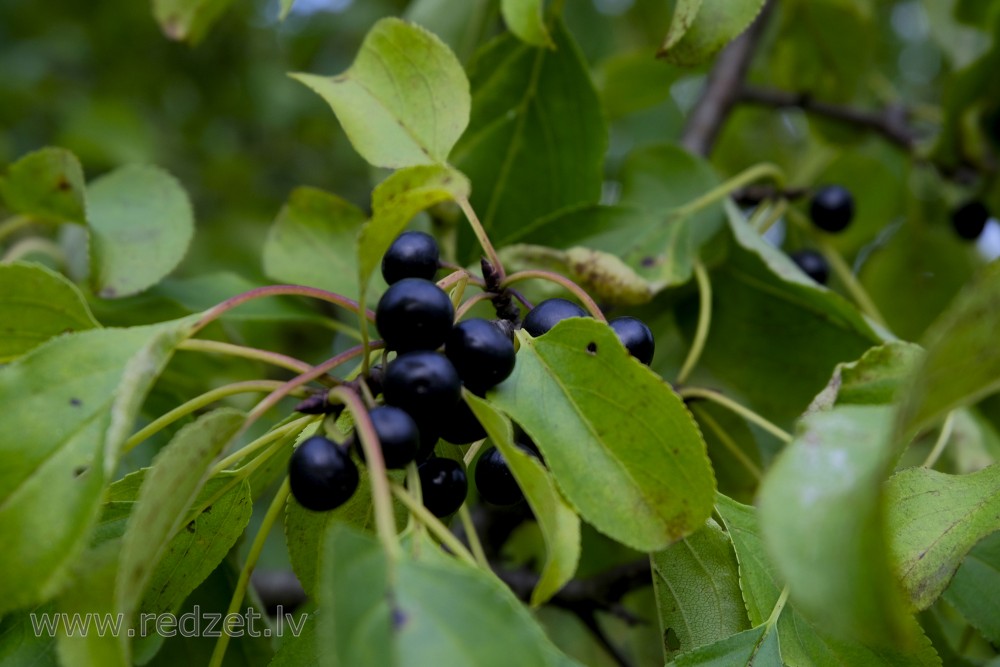
(Rhamnus cathartica) Common buckthorn
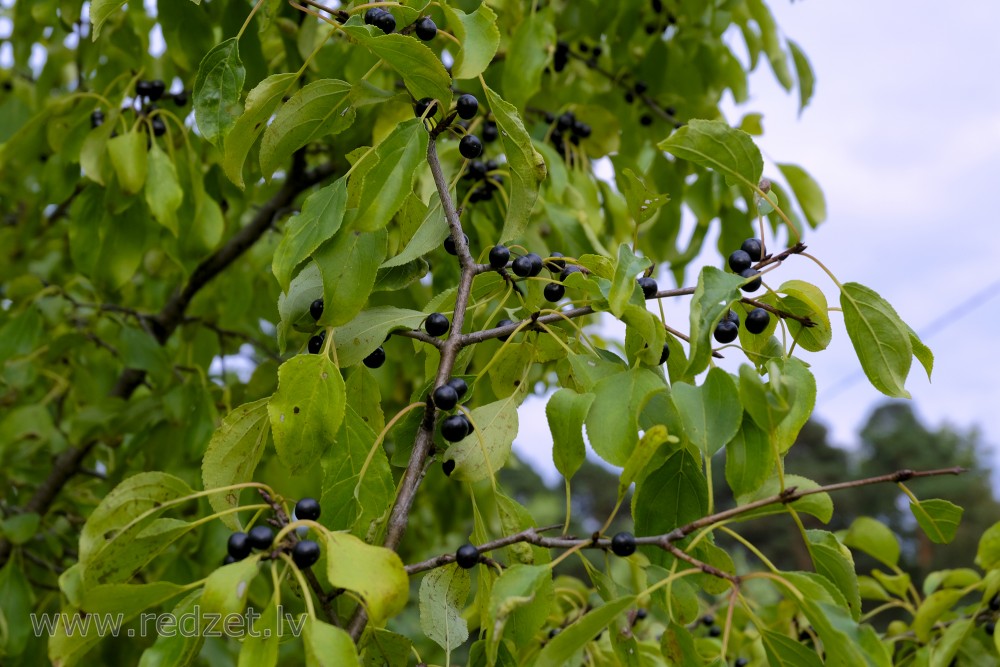
Rhamnus cathartica, the buckthorn, common buckthorn or purging buckthorn, is a species of small tree in the flowering plant family Rhamnaceae. It is native to Europe, northwest Africa and western Asia, from the central British Isles south to Morocco, and east to Kyrgyzstan. It was introduced to North America as an ornamental shrub in the early 19th century or perhaps before, and is now naturalized in the northern half of the continent, and is classified as an invasive plant in several US states and in Ontario, Canada.
Description
Rhamnus cathartica is a deciduous, dioecious shrub or small tree growing up to 10 metres (33 ft) tall, with grey-brown bark and often spiny branches. The leaves are elliptic to oval, 25–90 mm (1–3 1⁄2 in) long and 12–35 mm (1⁄2–1 3⁄8 in) broad; they are green, turning yellow in autumn, and are arranged somewhat variably in opposite to subopposite pairs or alternately. The flowers are yellowish-green, with four petals; they are dioecious and insect pollinated. The fruit is a globose black drupe, 6–10 mm (1⁄4–3⁄8 in) across, and contains two to four seeds.
Toxicity
The seeds and leaves are mildly poisonous for people and animals, but are readily eaten by birds, which disperse the seeds in their droppings. The toxins cause stomach cramps and laxative effects that may function in seed dispersal. The chemical compounds responsible for this laxative effect are anthraquinone and emodin. The species name cathartica and the common name purging buckthornrefer to this effect.
In 1994, R. cathartica was implicated in the outbreak of an idiopathic neurological disease in horses, although no causative agent was officially identified. In trials where rodents were fed the leaves and stems of R. cathartica, glycogen metabolism became abnormal and glycogen deposits formed in the cytoplasm of liver cells. Abnormalities in glycogen metabolism lead to diabetes in humans.
Ecology
Rhamnus cathartica is shade-tolerant, moderately fast-growing and short-lived. It is a food plant of the brimstone butterfly, Gonepteryx rhamni. The sulphur-yellow males are indicative of the presence of this species or of its alternative host, Frangula alnus.
This species is the alternate host for the important rust disease of cereals caused by Puccinia coronata. Rhamnus cathartica is also the primary overwintering host in North America for an important agricultural pest of soybeans, the soybean aphid.
Uses
The bark and fruit of Rhamnus catharticus were used as a purgative in the past, although their potentially dangerous violent action and side-effects means they are now rarely used. The wood is hard and dense, but little-used.
en.wikipedia.org
https://en.wikipedia.org/wiki/Rhamnus_cathartica
Continue reading